
Odorous House Ant
Scientific Name
Tapinoma sessile
Size
1/16 – 1/8″
Key Features
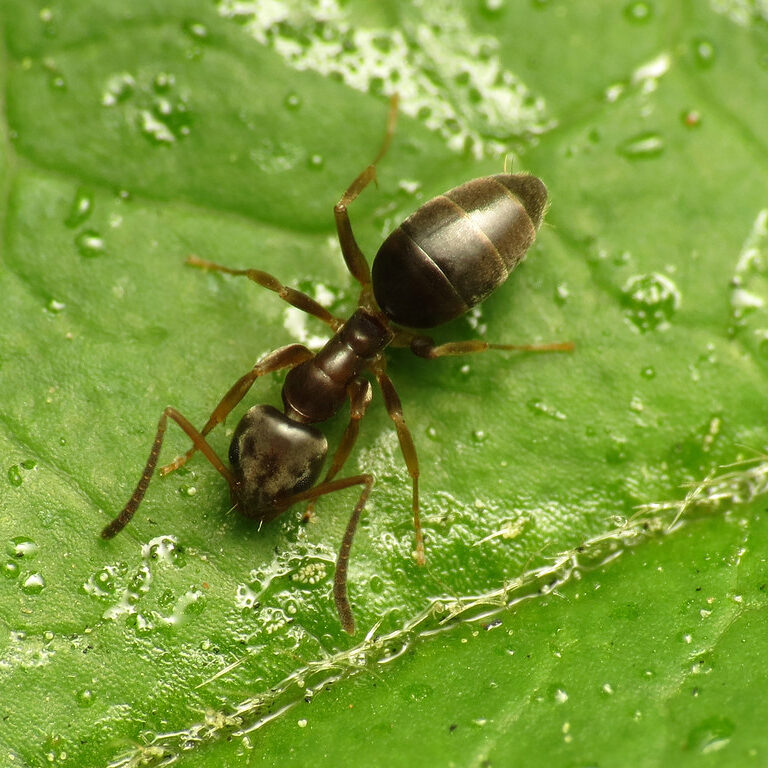
- Brown to black body
- Petiole with 1 node, partially covered by abdomen
- Releases a coconut odor when crushed or disturbed
Biology and Habits
Odorous house ants form large colonies consisting of many queens and her workers. Swarmers appear from May to mid July. Nests can reach enormous sizes ranging from several hundred to 10,000 ants. Up to 5 generations of ants may be produced in a single year. Nests can be found in many, sometimes unusual, locations. Common nesting sites are within wall voids, outlets, under potted plants, mulch, firewood, or other locations that provide suitable protection. Entire colonies are capable of relocating if conditions change or if a scout discovers a more ideal nesting site. These are the ants most often seen indoors after heavy rains. Odorous house ants are fond of honeydew produced by aphids, mealybugs, and scale insects and they will readily feed on sweets indoors. Workers can be seen trailing in large numbers leading to multiple nest locations. Odorous house ants are quick moving, will frequently climb onto countertops and walls and will release a pungent coconut-like odor when disturbed or crushed.
Control
Control of odorous house ants can be achieved with baits, however this requires much patience and frequent rebaiting as colonies can be quite large and contain dozens of queens. Baits should be placed near active trails of workers. Whenever possible, workers should be followed back to their nests. If a nest is discovered, control can be achieved with a direct treatment with an appropriately labeled liquid or dust insecticide. Barrier treatments around the exterior perimeter can prevent entry by foraging workers.
Need help identifying or controlling this pest? Give Revolution Pest Defense a call or send an email for a free inspection.