
Citronella Ant
Scientific Name
Lasius interjectus
Size
1/4″
Key Features
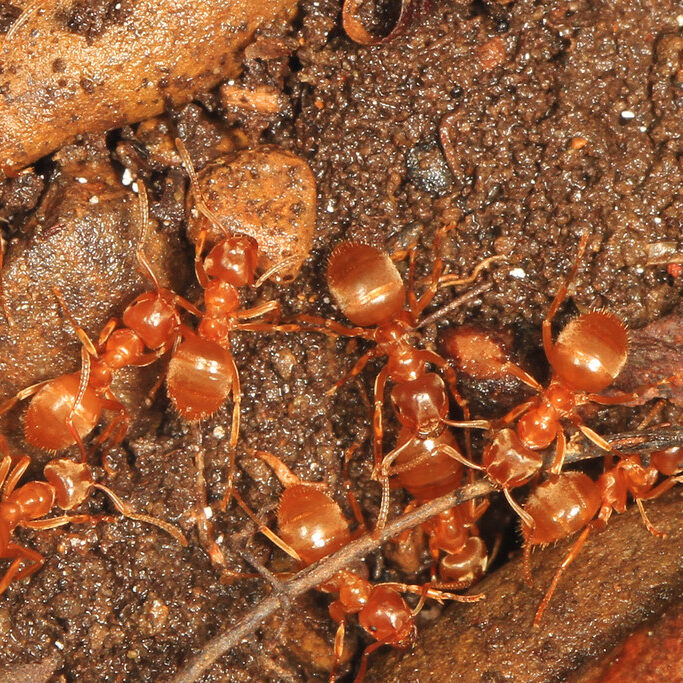
- Yellow to orange body
- Produce a citronella odor when disturbed or crushed
Biology and Habits
Also known as the larger yellow ant, citronella ants are a subterranian species of ant which forms colonies consisting of a single queen and her workers. Winged swarmers appear throughout late summer and fall and may be active at night. Colonies will sometimes temporarily relocate indoors, particularly in crawlspaces and foundations, however, they normally move back outside in the spring. Citronella ants tend aphids and mealybugs for honeydew and do not forage for food in homes.
Control
Citronella ants do not invade homes to forage food, do not cause damage, and are not normally encountered, except when swarmers are present. Control for this species is usually not warranted. If control is desired, the nest must be located and the entrance treated with an appropriately labeled insecticide. Look for mounds of deposited dirt or sand near foundations or in crawlspaces. Baits are ineffective on this species of ant as they feed exclusively on honeydew.
Need help identifying or controlling this pest? Give Revolution Pest Defense a call or send an email for a free inspection.
Baker, J. (n.d.). Larger Yellow Ant . Larger Yellow Ant | NC State Extension Publications. https://content.ces.ncsu.edu/larger-yellow-ant
Jacobs, S. (n.d.). Citronella Ants. Penn State Extension. https://extension.psu.edu/citronella-ants
Yard and Garden. (n.d.). Larger Yellow Ant. Iowa State University Extension and Outreach. https://yardandgarden.extension.iastate.edu/encyclopedia/larger-yellow-ant