
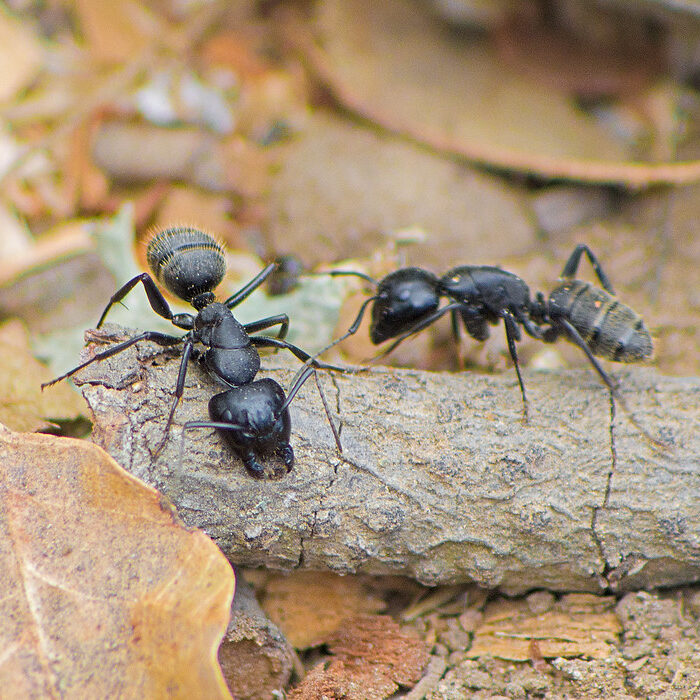
Carpenter Ant
Scientific Name
Camponotus pennsylvanicus
Size
1/4 – 1/2″
Key Features
- Black body with yellow hairs on abdomen
- Petiole with 1 node
Biology and Habits
Carpenter ants form large colonies consisting of a single queen and her workers. Winged reproductives appear from May – August. Size varies considerably between workers, with smaller individuals sometimes associated with younger colonies. Carpenter ants do not eat wood, instead they create galleries in old, moisture damaged wood, leaving behind “frass”, a sawdust like material. A colony may include a single primary colony and multiple satellite colonies. Populations in primary colonies can contain over 3000 ants, but may reach over 15,000 including satellite nests. Nesting locations are typically outdoors in trees, fallen logs, wood piles, sheds, wooden playgrounds, and sometimes under weed barriers or inside hot tubs. When nesting indoors, carpenter ants are typically found in areas of high humidity where wood may be damaged. These locations include window and door frames, inside walls near bathrooms and kitchens, in crawlspaces, or sometimes in insulation. Colonies are slow to grow so the appearance of workers indoors may indicate an established colony at least 2-3 years prior. Knowledge of past water damage is key to discovering the location of indoor colonies.
Carpenter ants forage for a wide range of foods, including sweets, proteins, grease, and other household goods. They can travel up to 300 feet in any direction from their nest, so presence of ants in the home does not always mean a nest is located nearby. Carpenter ants are most active at night and do not normally travel in concentrated trails like other ant species. While carpenter ants do not sting, they are capable of inflicting a painful bite.
Control
Carpenter ants can be best controlled by locating and directly treating the nest. This can be accomplished by following foraging workers back to the nest, or by inspecting nearby trees or wood. Look for cracks or rotting knots in trees and search for the presence of sawdust like material mixed with ant parts. Carpenter ants create small “windows” where they enter their colony. Sometimes ants can be spotted poking their heads out to deposit frass. Indoors, search for areas where moisture damaged wood may be present. Knocking on walls may stimulate the ants, resulting in a “crackling” sound as they scrape the wood with their mandibles. A moisture meter may come in handy in locating potential nesting sites.
If a nest is discovered, apply an appropriately labeled aerosol, dust, or liquid insecticide directly into the entrance of the nest. A barrier treatment around the exterior perimeter will help prevent entry by foraging workers. Baits are also effective when placed in high traffic foraging trails or near nest entrances. However, this method is slower acting and if misapplied, may be ineffective. Timing of baiting is especially important as the workers are most active at night. Bait placed in the morning may be taken by other species of ants first.
Need help identifying or controlling this pest? Give Revolution Pest Defense a call or send an email for a free inspection.
Bennett, G. W., Owens, J. M., & Corrigan, R. M. (2014). Truman’s Scientific Guide to Pest Management Operations (Seventh). North Coast Media, LLC.