
Bald-Faced Hornet
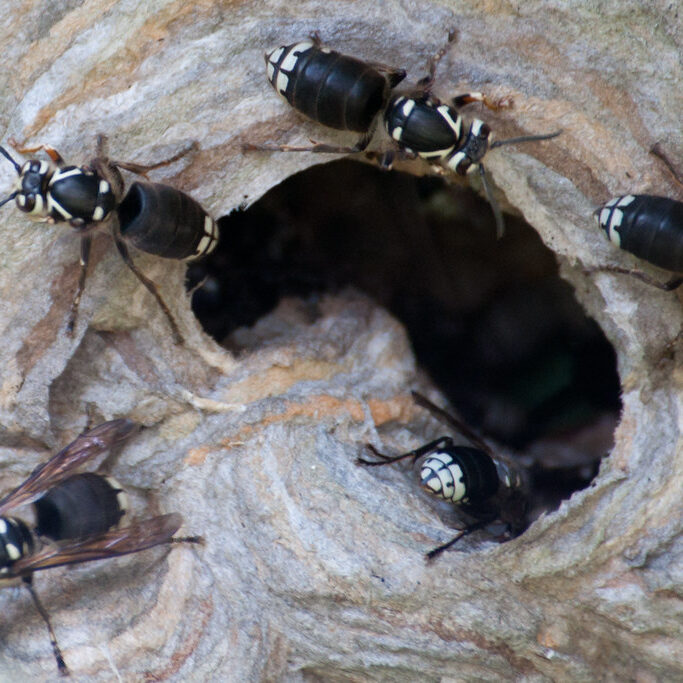
Scientific Name
Dolichovespula maculata
Size
5/8 – 3/4″
Key Features
- Black and yellow or white
- Large hanging paper nests
- Compact body
Biology and Habits
Despite their common name, bald-faced hornets are actually a species of aerial nesting yellowjackets and are not true hornets. They are social insects forming large colonies consisting of a queen and infertile workers. Colony size varies, but under ideal conditions, populations can reach up to 400 or more wasps. At the beginning of each season in spring, inseminated queens will emerge from hibernation and seek out suitable locations to build a nest. Nests are typically built high in trees, shrubs, or hanging off of structures. The queen will care for her first batch of workers before turning full time to egg laying. Nests are constructed from wood mixed with saliva to produce a papery pulp, which is used to create cells for larvae and a carton to protect the nest. Later in the season, males and new queens are produced and begin to mate. The colony will then begin to die off with only the new queens entering hibernation to begin the cycle anew next spring. Bald-faced hornets create brand new nests each year, so removal of old nests is not necessary.
Bald-faced hornets are highly aggressive when their nests are disturbed. The entrance of the nest is protected by guards who will use pheromones to alert the colony of danger. Each wasp is capable of stinging multiple times.
Control
In most cases, bald-faced hornet nests are built in locations that do not pose a risk to people and pets. Often times, nests aren’t discovered until the fall when leaves have fallen from trees. In situations where they may come in contact with people or animals, control may be necessary. Appropriately labeled aerosols or dusts should be applied the entrance of the colony to quickly kill the workers. After the colony has been eliminated, it is recommended to remove the nest to prevent developing larvae to later emerge as adult wasps.
Need help identifying or controlling this pest? Give Revolution Pest Defense a call or send an email for a free inspection.